

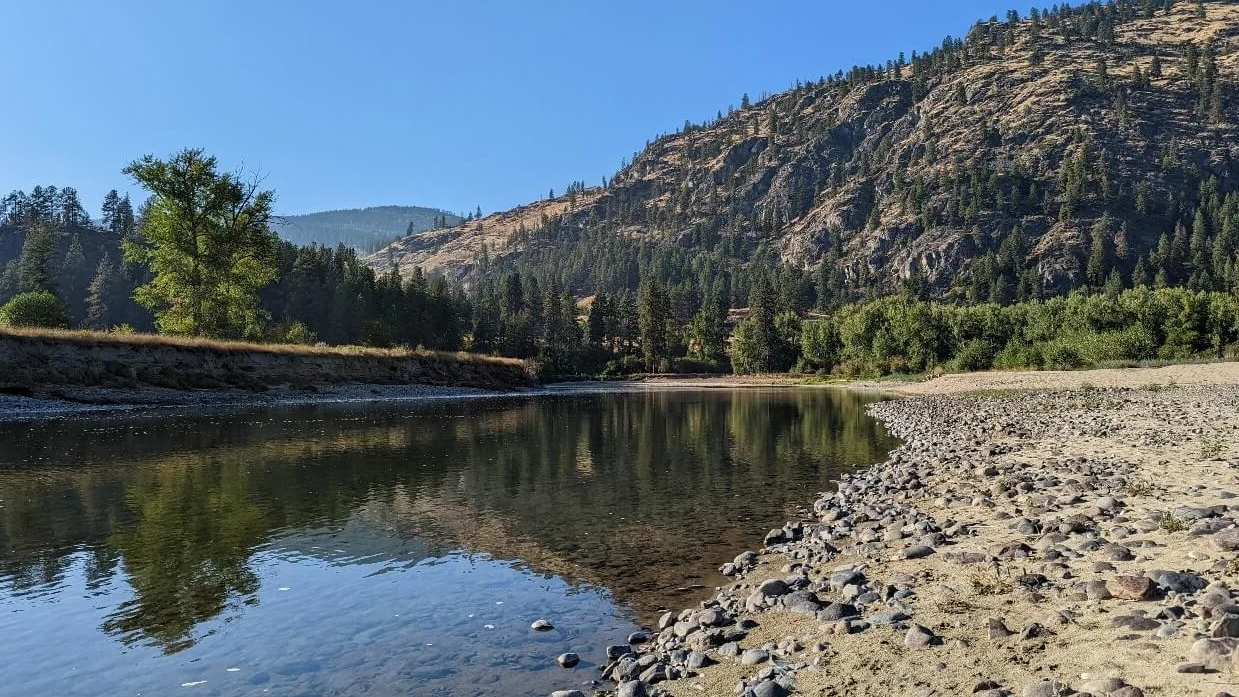
One would be forgiven for driving past Boothman’s Oxbow Park, situated beside Highway 3 between Grand Forks and Christina Lake, without more than a glance.
Not because the park is unappealing—quite the opposite, in fact—but because it is hidden in plain sight.
Narrowly glimpsed from the Crowsnest Highway, Boothman’s stretches across 200 acres of beautiful and unique protected land in the heart of the Kootenay region.
The BC park is perhaps most famous for being home to one of the oldest oxbows in the province, a feature that has captured the imagination of locals and visitors alike for generations.
Wait, most people ask. What’s an oxbow?
The oxbow is a natural phenomenon that forms in the wake of meandering rivers. Picture a flowing river, moving with the force of gravity, winding and turning snakelike through terrain. As the river flows, it carves a channel through the earth, eroding its outer banks while depositing sediment on the inner banks. This gradual process continues over hundreds and thousands of years until the river meanders so much that it creates a bend that doubles back on itself.
That bend is an oxbow.
Based on geological studies, it is estimated that the oxbow in Boothman’s park is more than 10,000 years old, when melting glaciers forged forces of water such as the mighty Kettle River. As far as fascinating natural formations go, oxbows are up there, and Boothman’s is among the most impressive in British Columbia.
The park also has significant riparian, grassland and wildlife values, according to BC Parks, “including a rare riparian black cottonwood ecological community and numerous provincially red- and blue-listed animal species.”
Over one kilometre of the park’s southern boundary is riparian frontage along the Kettle River.
Discover more from THE MIDWAY ADVANCE
Subscribe to get the latest posts sent to your email.

