

Last year, while researching for an essay, I clicked on the “Ethics” page of a journalist association. Immediately I was presented with an “Error 404”—This page doesn’t exist!
It was a fitting metaphor for the state of journalism today. What happened to news, anyway?
I am not so naive as to suggest that newspapers were ever perfect, unbiased, altruistic, or always transparent and correct. However, I do carry good reason to believe that there was a time when newspapers and magazines strived, at a bare minimum, to deliver accurate and objective information—and managed to do so without forcing uncouth agendas down readers’ throats.
It may not have been a perfect system—which manmade one ever is?—but news publications did well when their motivation was to shine light near Truth rather than haul water for thirsty corporate conglomerates and insatiable political regimes.
Of course, this was quite some time ago now.
Today, in their current form, most newspapers in existence do more harm than good—and that opinion is coming from a lifelong journalist.
People Vs Power
In the twenty-first century, major and minor newspapers alike have become weaponized by agenda-driven institutions and the activist billionaires funding them. It sounds like some big conspiracy theory but the facts are in plain sight.
Mainstream and niche newspapers alike are increasingly hijacked by large institutions and billionaire benefactors, casting an ominous shadow on the once revered Fourth Estate. Such compromised press corps are not just useless, but often actually dangerous to a free society—when a “journalist” is reduced to activist or messenger, the citizen body can be harmed through misinformation.
Now imagine an entire population of misinformed citizens. Do you expect that society of function healthily and in favour of its people?
When information is supplied strictly top-down, power and control funnel upward. We see this in 2023 with newspapers reporting objectively false realities as unassailable fact—such as “men are women” and end-is-nigh style fear-mongering about weather patterns—while skirting around genuine issues impacting Canadians. As a result, the typical Canadian is operating on a severely skewed perception of affairs.
To contribute value, reporters must play a kind of reverse-Telephone game, stripping obtuse political rhetoric of its veil so that the citizen public might observe Oz for who he is. This peeling back of curtain does not occur when a journalist idolizes or works for her subject; objectivity is dented when a writer is burdened by incentives that may conflict with Truth.
Despite the modest remuneration and societal respect it commands, journalism remains a cornerstone of any free and open civilization. Anywhere in the world it has worked, journalism has been taken for granted. Yet where there is no freedom of press, freedom of people too is scarce.
The profession has always been a check to power, leveraging free speech and the power of the almighty written word to balance the cosmos. Good journalism orders chaos. Dishonest journalism creates chaos.
In the spread of fake news to manipulate a populace there is no balance or even productivity, just waste. If we cannot have journalism, we are better off to have nothing.
In the absence of journalism, society is left grappling with a parade of counterfeits—which is where “more harm than good” comes in to focus. Filling the void of critical reportage is a garden variety of misshapen impostor: paid “influencer” content alongside government-born propaganda re-issued to the public without analysis or context.
Fiction is presented as fact; facts are contorted to fit the fiction; the reader is taken for a fool and played like a fiddle on his own dime. Here’s what to think about this, not, here’s everything we know about this for you to think about.
The “Five Ws” of journalism—Who, What, When, Where, and Why—are rolling in their graves.
Even the largest and most-respected newspapers have bent the knee to non-journalistic deities such as profiteering capitalists and the State, which has a longstanding history of spending taxpayer funding to brainwash its own citizens.
In Canada, the Canadian Broadcasting Corporation of Canada receives $1 billion per year in tax money to run programming with a taint in favour of the political party in power. More than two-thirds of CBC’s funding is from taxpayers, and much of it is spent on propaganda. In this light, Canadians have no ability to object to funding their own brainwashing. They can leave their television off and not engage with CBC content—but as taxpaying Canadians they’re still contributing to State control.
It’s hard to find an allegedly reputable publication, public or private, without taint. The Walrus recognizes the state of things—”In a post-truth world of fake news and misinformation, fact-checked journalism has never been more important,” the magazine posits—while pushing its own partisan agenda nonstop through an “educational mandate.”
In BC, the Tyee claims independence and devotion “to fact-driven stories, reporting and analysis” even as it is time and time again publicly called out for pushing bias. They relentlessly reported on the “mass graves” hoax without ever apologizing after it was exposed as falsehood. Even more recently, the Tyee unduly slandered those marching against ideology in schools as an evil force.
Hilariously, the Tyee’s slogan on X is to “swim against the current.” How Orwellien, given the Tyee is the current.
BC’s only two province-wide newspapers—The Province and The Vancouver Sun—are owned by the same behemoth. How does that serve a population fairly? As is the case with our political parties, we enjoy merely an illusion of distinction; BC is left with but one voice on most matters.
Beyond Canada, consider how Amazon billionaire Jeff Bezos bought the Washington Post; sports magnate John Henry acquired the Boston Globe; billionaire Patrick Soon-Shiong owns the Los Angeles Times; Laurene Jobs scooped up the Atlantic; Chatchaval Jiaravanon owns Fortune; and Salesforce founder Marc Benioff acquired Time.
Given that newspapers tend not to be profit machines, it can be surmised that wealthy elites are investing in these press companies for non-financial returns. With material goods already in possession, acquiring influence and power becomes more interesting and valuable to the elite class.
Perhaps that is one reason why these papers all operate on agendas so thoroughly detached from journalism.
A Return to Real Reportage
I cannot truly speak to the motivations of billionaires, suspicious as they may be. But I can tell you what, as a seasoned journalist, I observe every day from these so-called news organizations: constant fear-mongering on issues of the day, blatant partisanship with regard to political coverage, and wildly inconsistent accuracy levels across domains.
The Internet could have unlocked the best aspects of news but instead it has simply opened the floodgates to abuse of information. The quest for clicks has spurred outlets to chase sensational stories, often at the expense of balanced reporting. Pressure to publish rapidly means less time for fact-checking and critical analysis. Edits and corrections after the matter are rare and ignored besides.
Infowars‘ Alex Jones was right when he said that we are in the midst of an “information war,” and it’s an ugly battlefield: children and teens addicted to screens and social media, rising rates of suicide and mental illness and drug abuse, and a plague of public lies to the point that taxpaying citizens cannot trust their own leaders to speak honestly.
Already, some Canadians are tapping out of the fight. Findings from the 2023 Digital News Report by the Reuters Institute for the Study of Journalism at the University of Oxford reveal a notable dip in Canadians’ news consumption and willingness to pay for online news.
Fewer Canadians are showing interest in news, the data shows, even on modern platforms like social media. Alongside lower consumption rates, trust in news continues to plummet. Only 37% of anglophones expressed trust in most news, for example.
Who can blame the skeptics? One would need to maintain their head deep in the sand to take mainstream news at face value in 2023.
British Columbia deserves journalism. More than ever, we need it, because currently we have less of it than ever.
Take as a Boundary Country example the Grand Forks Gazette . The publication is owned and operated by partisan conglomerate Black Press Media. Despite occasional perform local journalism, the Gazette ultimately submits to the authority of its master editor, serving as an arm to deploy climate alarmism and other political nonsense without a hint of journalistic scrutiny from newsrooms with paper-thin workforces. For example, in reference to race, the biased Gazette capitalizes “black” but not “white”—just one of the many subtle ways the newspaper sows division under the guise of journalism.
This is not something that everyone knows about their “local” paper—how it’s not local anymore. The racist Gazette states its ownership problem in common with nearly every other “local” paper in the region: Consider the Nelson Star, the Trail Times, Castlegar News, the Boundary Creek Times, Rossland News, the Revelstoke Review, and Arrow Lakes News—not to mention hundreds of others across Canada and the United States.
Owned by larger Canadian and even American interests, the local voices of small communities are no longer heard—their opinions no longer appear in the pages of their own town’s paper. This is a big problem.
A few minor holdouts appear to remain. For example, the Boundary Sentinel, Nelson Daily, Castlegar Source, Rossland Telegraph, and Kootenay Planet are all part of Lone Sheep Publishing, a Boundary-based network of independently owned newspapers linked together to share content, ads, and resources.
Overall, however, the integrity of the field of journalism has disintegrated, from the local to the international level—in Boundary Country, throughout BC, across Canada, and beyond.
I lament the corrosion of journalism because I exalt the height of the profession: at its pinnacle, the craft is a potent combination of science, art, and tool. Good journalism is powerful, impacting, lasting.
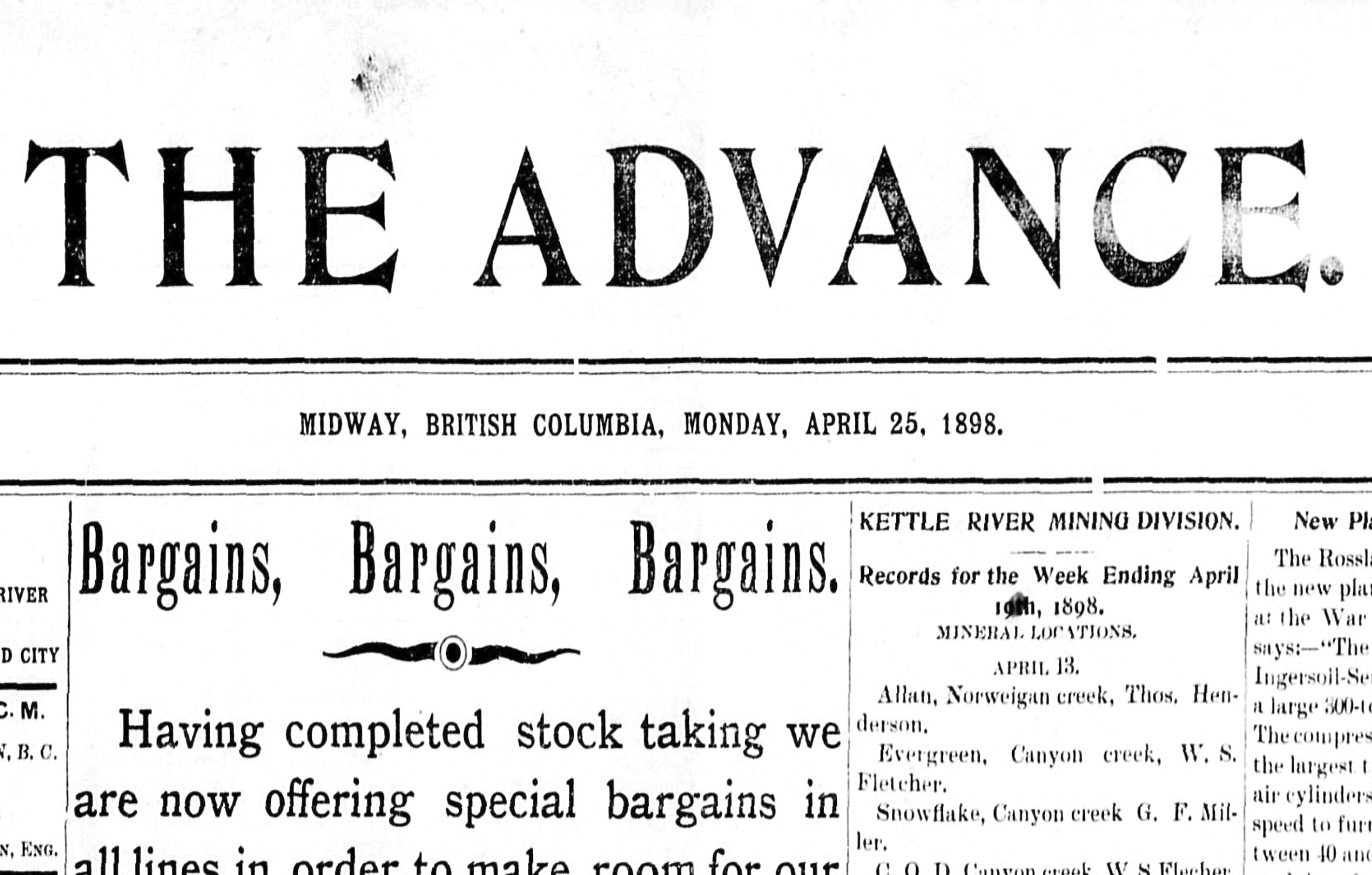
But bad journalism is a waste of everyone’s time. To have seen one and to now live with the other is a troubling transition. That is in part why I started the Midway Advance: to return financial independence to journalism, to return objectivity to facts, and to restore the grassroots element of local reporting.
The Advance trudges forward with clear aim: To resurrect authentic journalism here in British Columbia, Canada. We operate from a founding set of principles focused on local reporting and independent editorial.
Editor-in-Chief
Midway Advance
Discover more from THE MIDWAY ADVANCE
Subscribe to get the latest posts sent to your email.

